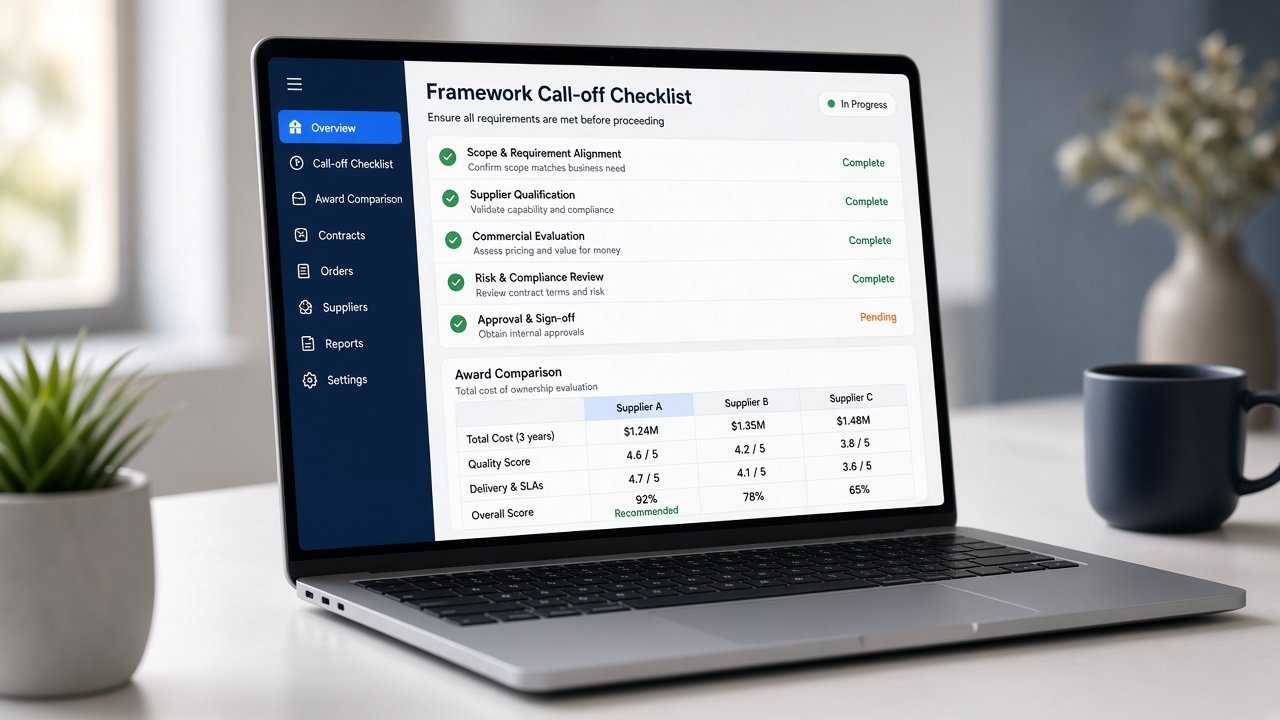
The myth that a framework means you are safe still comforts busy teams. Pick a lot, run a mini-competition, award fast. In practice a framework only moves risk; it does not remove it.
Frameworks are useful. They are not a shield. A call-off can still fail on the requirement, the evaluation, or the commercial terms you accepted without reading the parent agreement carefully.
Why the myth fails
Someone else designed the framework for their problem, their suppliers, and their risk appetite. Your need may not match. Lots can be too broad, pricing schedules can hide whole-life cost, and direct awards can skip the challenge you actually needed. Audit and challenge still ask whether you used the route properly and whether the award is defensible. “It was on a framework” is not an answer.
Teams also treat framework membership as proof of quality. Being listed means a supplier passed a gate at a point in time. It does not mean they can deliver your outcome next quarter.
What to do instead
Start with your commercial problem, then ask whether this framework is the right route. Check the lot scope, the call-off rules, the evaluation freedom you still have, and what you cannot change. Write a short call-off that tests the outcome you need, not only the catalogue description. Keep an evaluation trail as clean as you would for an open tender. If the framework cannot carry that, use a different route.
A practical next step
Before your next call-off, open the framework and answer three questions in writing: does this lot fit the problem, what must we still evaluate, and what would a bad award cost us later? If those answers are fuzzy, a short thirty-minute call is often enough to reshape the call-off before you issue it.